The Barge
I take an anchored cargo vessel as both site and subject, tracing the entanglements between extraction and disappearance — between imperial infrastructure and vanishing memory. Dispossession is not always legible. It surfaces in torn landscapes, excavation sites, dried marshes and dump yards, but often registers only as a low-frequency signal: blurred, almost invisible, fraying into mist, as if language itself were caught in an opaque fog.
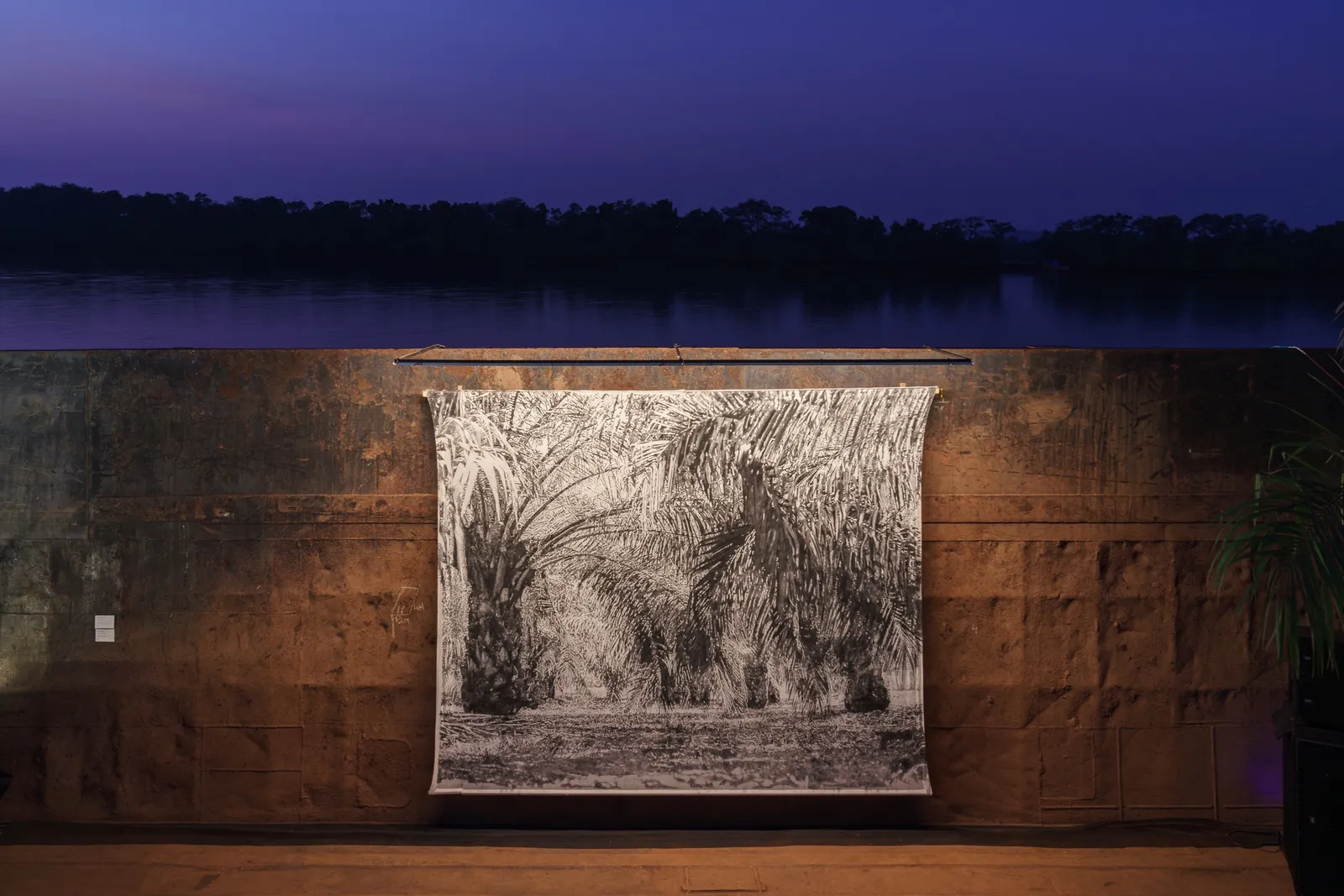
At the centre stands the oil palm. “Trees are alphabets, said the Greeks,” wrote Roland Barthes; among all tree-letters the palm is the most beautiful, possessing writing’s essential effect — the fall. Here the palm is both sign and surface, emblem of the extractive economies — palma africana — that have underwritten centuries of colonial conquest and industrial expansion. Hailed as a beacon of green energy, it hastens the unravelling of the very climate it promises to save. My charcoal drawings enlarge it into blown-up details, chopped-off parts, fragments and residues; images and materials decompose and recompose.
Around them the vessel keeps its own records. Chalk numeration runs across the rusted steel of the cargo hold in an eccentric graphorrhea, open to interpretation — a count of the palm oil trade, a Mayan calendar, an accounting of unspoken atrocities? Surfaces become palimpsests, overwritten and erased until the numbers turn to pure abstraction. Hung against them, my drawings ask for the same close attention the vessel’s own markings demand: ruins, collapsed infrastructures, bridges leading nowhere — a way of reading the landscape through the details of the world.