How Many Times?
An Introduction to the Practice of Julien Segard
An essay
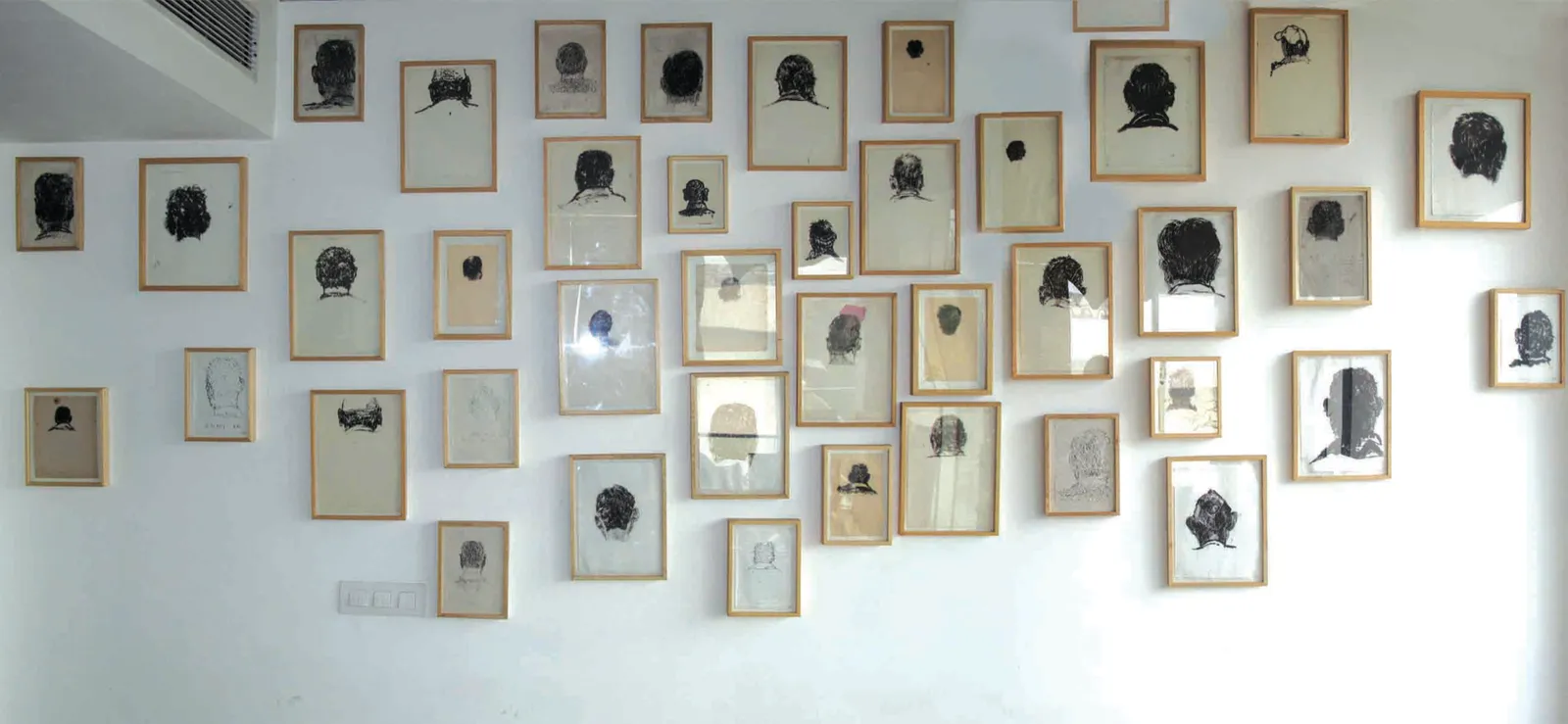
The question is not rhetorical. It is the rhythm of the work itself — the repeated gesture, the accumulated difference, the slow wearing-away that is also a building-up. How many times must one draw the same head before it becomes something else? How many times can a back be turned before a portrait becomes a landscape? How many times must charcoal be laid down and rubbed away before the paper itself becomes the subject? These questions open onto a practice that moves across territories, materials, and scales, yet is held together by a single, stubborn insistence: that looking is never neutral, and that the right to remain partially unseen is as fundamental as the right to be seen.
The images show two installations of a single series — dozens of framed charcoal heads, the back of a head rendered again and again, each slightly different, each bearing the marks of its own making and unmaking. The first, photographed in a domestic setting in Goa, with cane chairs and terracotta vessels and humid light filtering through, presents some thirty-odd drawings arranged across a corner wall. The second, a more clinical white-cube installation, shows perhaps forty or fifty works in a denser, grid-like formation. Both are composed of the same fundamental unit: a head turned away, refusing the face, refusing recognition, refusing the demand that the other be transparent, legible, fully known.
This is the entry point. But the door it opens leads elsewhere — to street chairs mended with wire and tape, to bunkers receding into dunes, to the undersides of flyovers, to scorched fabric and frottages of salvaged fragments, to a barge at Old Goa carrying drawings of oil palms on its rusted hull. What follows is a walk through that door.
I. The Refusal of the Face
To draw the back of a head is to refuse the face. The face is the site of ethics — the face of the Other is what calls me to responsibility, what interrupts my solitude with the demand of the infinite. But the back of the head is the face turned away, the subject who will not meet my gaze, the Other who withdraws. In these drawings, this withdrawal is not hostile; it is simply the condition of being. These are not portraits of individuals but of a condition: the condition of being-seen-from-behind, of occupying space without claiming it, of presence as residue.
There is a philosophy from the Caribbean that speaks of the “right to opacity” — a resistance to the demand that the other be transparent, legible, comprehensible. Against the imperative to know, to illuminate, to bring into the light, this thought insists on the dignity of the opaque, the right of the other to remain partially or wholly unintelligible. Opacities can coexist and converge, weaving fabrics. The viewer who approaches these works expecting to “read” a face, to “understand” a subject, to “know” a person, is met with the curve of a skull, the texture of hair, the fold of an ear — surfaces without depths, presences without disclosures. This is the irreducible, the simply-not-given.
This opacity is particularly resonant given the artist’s own position: born in Marseille, trained in Paris, living in India since the mid-2000s — first Delhi for a decade, then Goa. The postcolonial context is not explicit in these drawings, but it is structurally present. The history of colonialism is, among other things, a history of the demand for transparency — the demand that the colonized be legible to the colonizer, that their customs be explained, their bodies catalogued, their faces photographed and classified. Against this history, the back of the head is a quiet but radical gesture. It says: you may look, but you may not know. You may see, but you may not possess. The opacity is not defensive; it is sovereign.
II. Charcoal as Argument
The material itself is part of the argument. Charcoal is carbon, the elemental stuff of life and of its combustion. It is what remains after burning. It is, in a literal sense, the residue of life. The artist describes it as “a material that inscribes and wears away in the same gesture” — and this is not merely a technical property but an ontology. The charcoal head is being made and unmade simultaneously. It is emerging and disappearing in the same breath.
In the drawings, this dialectic is enacted at the level of surface. Some heads are dense, almost velvety with accumulated carbon. Others are faint, ghostly, as if the subject is already fading. Some have been aggressively rubbed, creating halos of grey around the central form. Others are crisp, decisive, almost architectural in their definition. The variety is astonishing — and it is precisely this variety that saves the project from mere repetition. Each head is a different event of charcoal, a different negotiation between the hand, the material, and the image.
This material logic extends across the practice. In Cold Was the Ground, scorched fabric and charcoal treat darkness as material rather than as the absence of light. In Dark Was the Night, dust and dyed cloth hold the cosmos at the edge of the visible. Charcoal is not a medium chosen for its expressive qualities; it is a medium chosen because it argues — because it embodies the very processes of inscription and erasure, of making and unmaking, that the work is about.
III. The Street Chairs of Chouf
At the center of Salvage Poetics are the street chairs of Chouf — painted in Delhi, mended with wire and tape, weathered by use and refused retirement. Behind them stands a Western legend: that the “savage,” or the traditional societies of the Arab-Islamic world and the Far East, had no seat of power — a story kept alive to prop up the claimed superiority of European societies. The chairs answer it quietly: each one still standing, on roadsides and rooftops, is the sign of an individual dignity maintained against the odds.
The connection to the turned-away heads is not obvious at first, but it is deep. Both are portraits of refusal — the refusal to be discarded, the refusal to be fully known. The street chair, mended again and again, is the back of the head made object: it has no face to present, no seat of power to claim, no transparency to offer. It simply remains, adapted, resistant, chouf — the Arabic word for “look,” but also, in this context, a command to see what is usually overlooked. Around the chairs gather the cycle’s other objects of survival: the sculptures of A Second Coming, among them One Stone, Two Houses, Three Ruins, and Four Gravediggers; the suspended found materials of Residuum; the frottages and salvaged fragments of Odds and Ends. Scavenged, repurposed, held in precarious balance, they are read through repair rather than decay: evidence of lives that adapt, resist and remain.
IV. Extractive Geographies
Three territories run through the work, held together not by proximity but by a shared structure of looking. The Étang de Berre, near Marseille — a childhood landscape, a Mediterranean lagoon ringed by one of the largest petrochemical complexes in the south of France — surfaces first in Falimente (2012), which takes Giacomo Balla’s 1902 study of a bankrupt shopfront and multiplies it to the scale of an economy, and returns in the charcoal forests of Dancing at the Edge of Memory and The Edge of Memory, reconstructed from memory at a distance. Distance is not treated as loss: the remembered territory arrives mixed with everywhere the artist has lived since, and the work takes that contamination as a collaborator rather than a corruption — a reading drawn from Anna Tsing’s The Mushroom at the End of the World. Delhi, where the artist lived and worked for several years, supplies its urban register: the undersides of flyovers, underpasses and interstitial spaces of Gut City Punch, Site(s), Fields and Tunnels and Emerging from the Grid — the gaps in the megacity’s fabric that offer refuge as much as ruin.
The most recent site is a barge moored at Old Goa, its rusted hull carrying charcoal drawings of palma africana — the oil palm, emblem of the extractive economies that underwrote colonial conquest and industrial expansion. “Trees are alphabets, said the Greeks”: what these works share is that way of reading — the landscape as palimpsest, dispossession legible in its details. The charcoal forests of the Étang de Berre, reconstructed from memory in a Goa studio, are the same gesture as the serial heads: a looking back at what is being worn away, a recording of what is being erased. The difference is scale — the head is intimate, the landscape is vast — but the operation is identical: to inscribe what is disappearing, to hold what cannot be held.
V. Concrete Afterlives
The bunkers of the Atlantic Wall, eighty years on: military architecture receded into the ground, read as archaeology rather than strategy. Built to command the coastline, the fortifications now tilt in the dunes like fossils of a war the landscape has almost finished absorbing; drawn in charcoal, ink wash and white chalk on aged paper, they sit somewhere between survey document and relic. The cycle belongs to a longer thread in the work — structures raised for power or survival, decommissioned, then re-read and re-inhabited — and extends the extractive geographies of the Étang de Berre, whose shores carry their own concrete remainders.
The bunkers and the heads share a temporal register. They are not getting better or worse; they are simply wearing down. The serial format of the heads makes this visible: head #1 is not earlier or later than head #47; they coexist in a present tense of continuous dissolution. The bunkers, too, are serial — a chain of concrete forms along the coast, each slightly different, each being absorbed by the same process. The artist describes this as “entropy as an evolution in reverse.” It is not decay as tragedy; it is decay as simply what happens, what has always happened, what will continue to happen.
VI. Dark Commons
Night, in this cycle, is not atmosphere but a position — a refusal of full legibility. Taking its bearings from Junichiro Tanizaki’s In Praise of Shadows, whose title the two-channel film borrows directly, these works treat darkness as material rather than as the absence of light. What is hardly visible by day — a landscape of small constructions, precarious settlements, objects adapting to their surroundings — is precisely what the night reveals. The cycle claims obscurity as a kind of shelter: the right of places, and of the people who inhabit their blind spots, not to be fully seen.
The turned-away heads are the human equivalent of this nocturnal logic. They are not hiding; they are simply not revealing. They are the blind spots of the social, the places where people adapt, resist, and remain without being fully catalogued. The Dark Commons cycle — with its scorched fabric, its dust and dyed cloth, its cosmos held at the edge of the visible — is the same operation at the scale of landscape and atmosphere. The right to opacity is not a personal preference; it is a structural condition of survival.
VII. Salvage Poetics
Around the street chairs of Chouf gather the cycle’s other objects of survival: the sculptures of A Second Coming, the suspended found materials of Residuum, the frottages and salvaged fragments of Odds and Ends. Scavenged, repurposed, held in precarious balance, they are read through repair rather than decay. This is the poetics of the work: not the poetics of the made, but the poetics of the mended, the held-together, the refused-retirement.
The serial heads participate in this poetics. Each head is a salvage operation — a drawing rescued from its own erasure, a form held together by the repeated gesture, a presence maintained against the odds. The charcoal that wears away is the same wire and tape that mends the chair. The seriality is the same as the repeated repair: how many times can you mend something before it becomes something else? How many times can you draw a head before it ceases to be a portrait and becomes a landscape? The answer is not a number; it is the work itself.
VIII. The Geography of Withdrawal
The artist’s biography is inscribed in these works, even if it is not legible as narrative. Born in Marseille, a port city with its own history of looking outward and inward simultaneously. Trained in Paris, the capital of the face, the city of flânerie and the frontal encounter. Then Delhi — a city of backs, of turned-away bodies, of the crowd that does not look at you because it is too busy surviving. And now Goa, where the pace slows, where one can look at the back of a head for a very long time without anyone minding.
The artist has spoken of his “fascination with the backside of the picture postcard landscape” — the desire to look where one is not supposed to look, to find beauty and meaning in the discarded, the overlooked, the infrastructural. The heads are the human equivalent of this infrastructural gaze. They are the backsides of people, the parts we do not photograph, the angles we do not celebrate. And yet, in the artist’s hands, they become luminous. The charcoal catches the light differently on a back of a head than on a face. There are no eyes to catch the light, no smile to reflect it. Instead, there is the curve of the skull, the texture of hair, the fold of an ear. These are the details of anonymity, and they are beautiful precisely because they ask nothing of us.
IX. Opacity as Relation
Every act of civilization is also an act of barbarism — the document of culture is simultaneously the document of barbarism. These heads might be read as a kind of inverse proposition: every act of not-seeing is also an act of seeing. To turn away is not to disappear. To refuse the face is not to refuse the other. The back of the head, rendered in charcoal, is a document of a different kind of encounter — one based not on recognition but on co-presence, not on identity but on shared space.
Opacity is not a barrier to relation but its very condition. We clamor for the right to opacity, not because we wish to hide, but because we refuse the violence of being fully known. The serial heads enact this right at the level of the image. Each head is opaque — not because it conceals a secret face, but because it simply is what it is: a back, a surface, a presence without depth. And in this opacity, a strange intimacy becomes possible. We do not know these people. We will never know them. And that is precisely what allows us to be with them.
X. How Many Times?
The title remains unanswered, and must remain so. The question is the rhythm of the work itself. How many times? As many as it takes. As many as the charcoal allows. As many as the wall can hold. As many as memory can sustain before it too becomes residue. As many as the street chair can be mended. As many as the bunker can tilt in the dune. As many as the oil palm can be drawn on the rusted hull. As many as the night can hold without becoming day.
The practice of Julien Segard is not a collection of separate series. It is a single, continuous gesture, repeated across scales and territories and materials: the gesture of looking at what is being erased, of inscribing what is wearing away, of holding what cannot be held. The turned-away head is the entry point because it is the most intimate version of this gesture. But the door it opens leads to the street chair, the bunker, the flyover, the scorched fabric, the oil palm on the barge. All are backs of heads. All are refusals of the face. All are claims on the right to opacity, the right to remain partially unseen, the right to simply be without being fully known.
This is the gift of the work: not the revelation of the other, but the preservation of the other’s opacity. Not the portrait that captures, but the portrait that releases. Not the face that demands, but the back of the head that simply is — charcoal on paper, presence as residue, identity as the beautiful, necessary fiction of the unseen. These are not failed portraits but successful relations: opacities that coexist and converge, weaving fabrics we do not need to understand in order to inhabit.