Installation
Terrains Vagues
The Servants' Bed
Bamako, Mali 2009
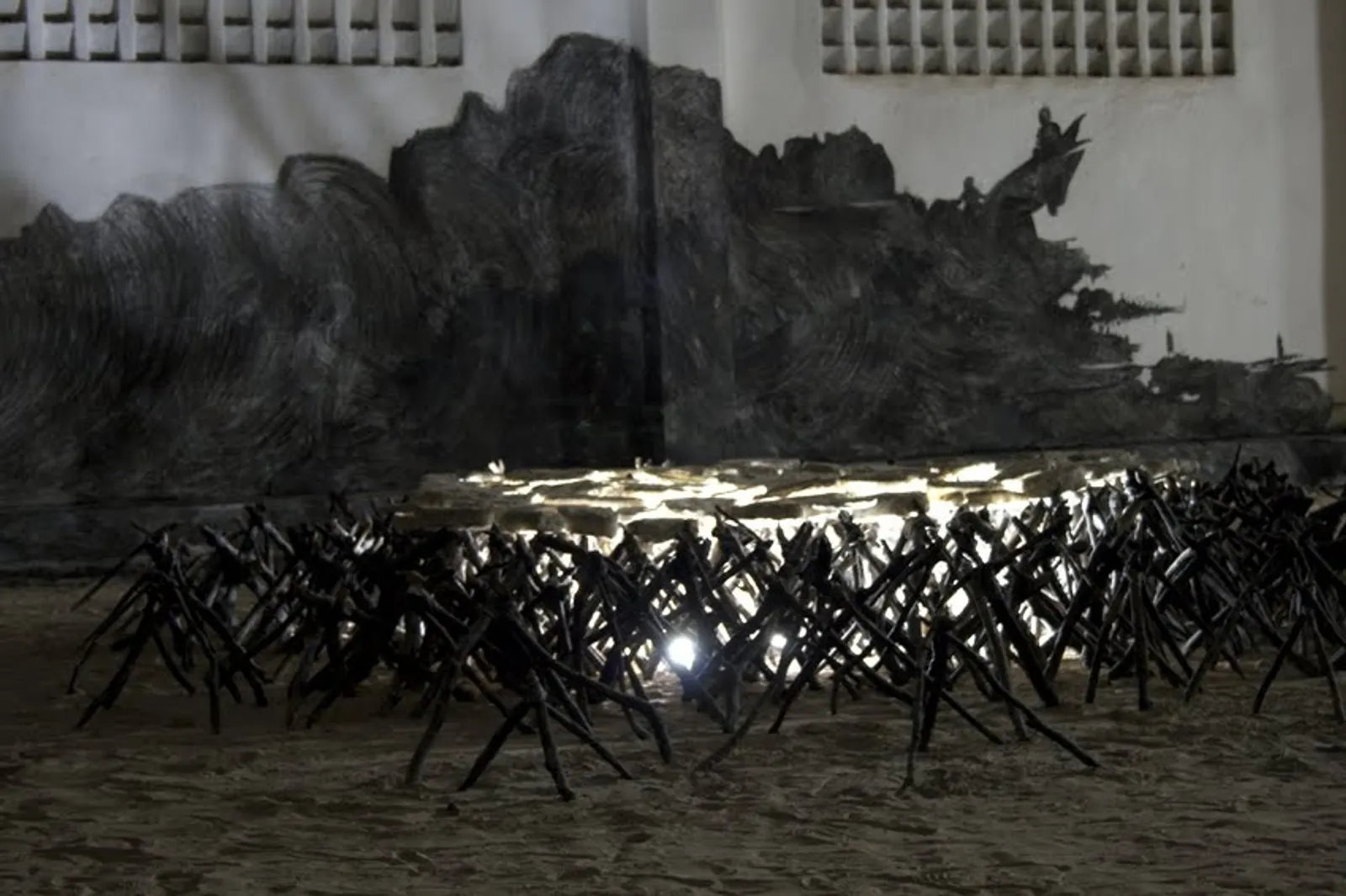
The exhibition Terrains Vagues unfolds like a slow caravan across contested ground — where the white walls of the gallery become the white expanse of the Sahara, and where every mark carries the sediment of exhaustion. Julien Segard does not merely depict Mali; he inhabits its contradictions, drawing in charcoal upon the far walls a vast, riverine landscape: the banks of the Niger, that ancient artery of life and commerce, with its rocky shores, its slender pirogues, and the silhouettes of fishermen who have navigated its currents for centuries. It is a scene of sustenance, of movement, of a world that flows. Yet Segard immediately troubles this fluidity with the mineral that has made the desert a site of death as much as exchange.
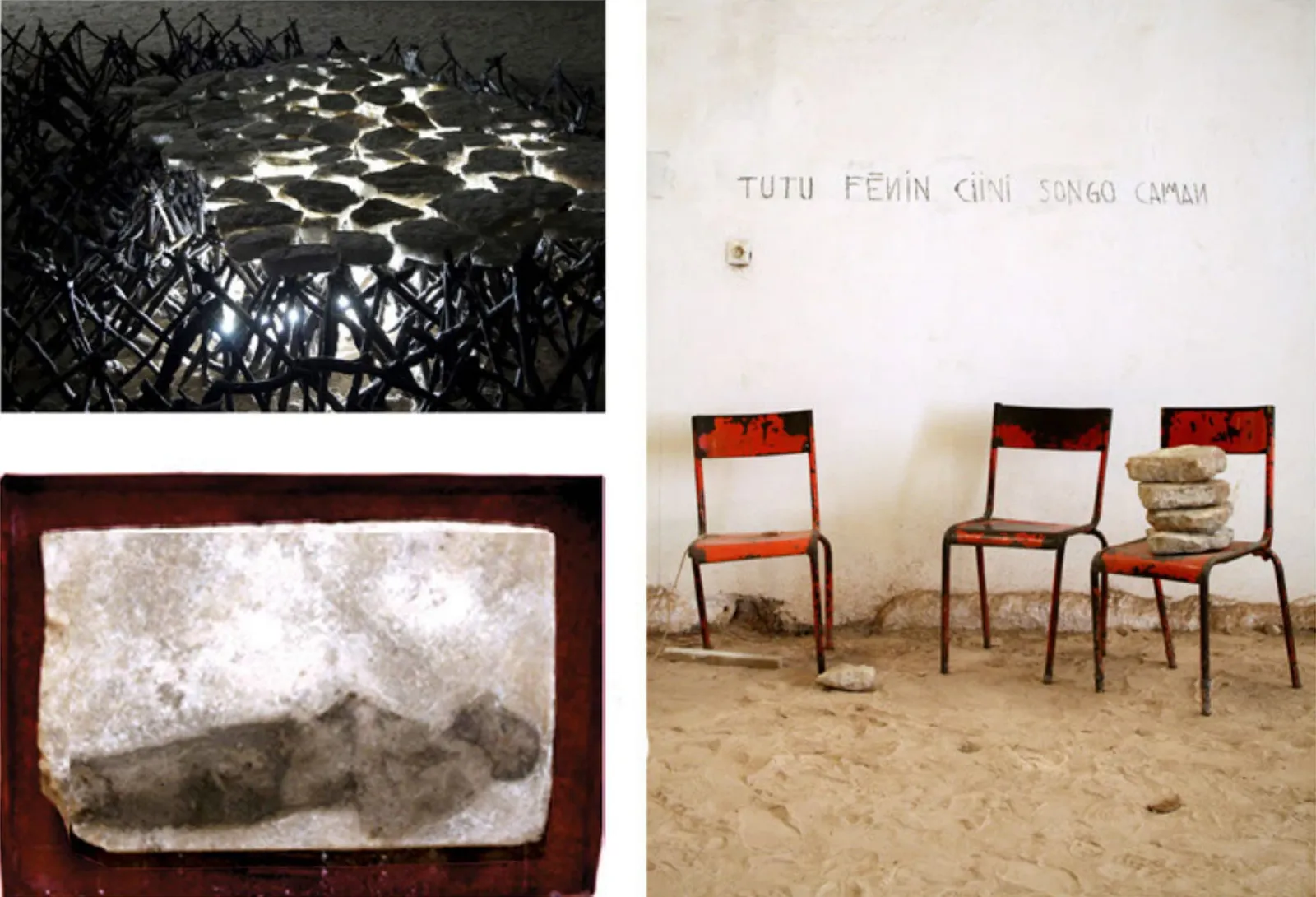
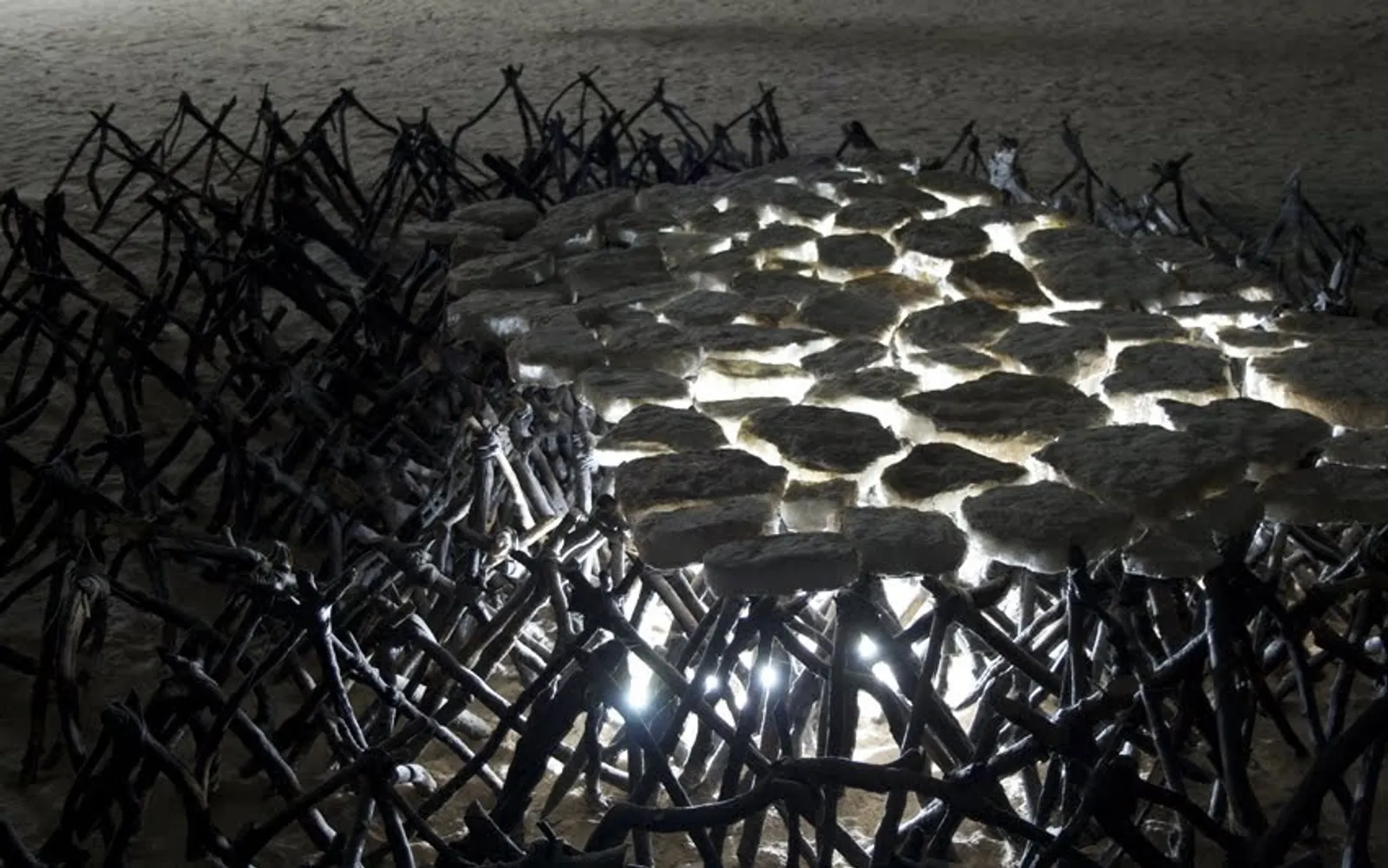
Against this drawn landscape, the artist installs The Servants’ Bed (Le Lit des Serviteurs) — an elliptical, unsettling structure composed of blocks of Taoudenni salt resting upon a tangle of charred wood. The salt slabs, each one quarried by hand from the ancient lakebed some 664 kilometres north of Timbuktu, become here both pavement and mattress: an unstable roadway evoking the gruelling azalai caravans, and a bed-frame of suffering upon which the body is broken by labour. For centuries, these same blocks were extracted by enslaved and bonded workers — Massufa slaves in the fourteenth century, Bella labourers in conditions of servitude today — who lose their health and weight to the saline pits, who sleep in huts built from discarded salt, and who remain trapped in debt to the caravan owners. Segard’s charred wood recalls the scorched earth of coercion, while the salt itself preserves, like a white tomb, the memory of those who mined it.
Upon this terrain of sleep and servitude, the servants themselves appear: eyes closed, overcome not by peaceful rest but by exhaustion, or perhaps by a sleep so deep it borders on absence. Segard renders them with almost unbearable delicacy — in wood soot and in watercolour — upon the canvas of a Picot bed or across the broken faces of the salt blocks themselves. It is a gesture of profound intimacy: to paint the sleeper upon the very substance of their oppression, to use soot (that residue of burning) and watercolour (that fluid, fleeting medium) to give tenderness to bodies that history has treated as disposable. These are not documentary portraits but spectral presences, witnesses who cannot quite open their eyes, yet who demand that we look.
And then, from this vast geography of extraction, Segard pivots to the infinitesimal. In A Very Small Thing, he isolates a fleeting instant around tea and chairs gathered for the grin — that West African circle of conversation and communion. Something minute and invaluable crystallises here: the silence of a witness standing in for the chanted voice of a departed friend. It is a work about substitution and surrogacy, about how the living must carry the songs of the dead. In the context of Taoudenni — where workers toil for nine months without seeing their families, where skeletons of camels litter the saline flats, and where the industry has remained “largely unchanged since at least the 14th century” — this small ritual of tea and memory becomes an act of radical resistance. Against the dehumanising scale of the salt economy, Segard offers the human scale of a shared drink, a remembered voice, a silence heavy with implication.
Terrains Vagues thus moves between the monumental and the miniature, the geological and the gestural. Segard’s charcoal Niger speaks of life and passage; his salt bed speaks of bondage and fatigue; his sleeping servants speak of a vulnerability that no labour can fully extinguish; and his small tea ritual speaks of the stubborn persistence of witness. Together, they form a topography not only of Mali but of conscience — wastelands, yes, but also terrains where art insists on tracing, however faintly, the dignity of those who have been made to serve.
The full text, in English and French, is at Terrains Vagues.
Documentation